For email marketers, domain reputation usually starts with one question: will my email reach the inbox?
That question built an entire industry — warmup, authentication, blacklist monitoring, inbox placement, deliverability. All of it matters. But it answers a narrower question than most marketers realize.
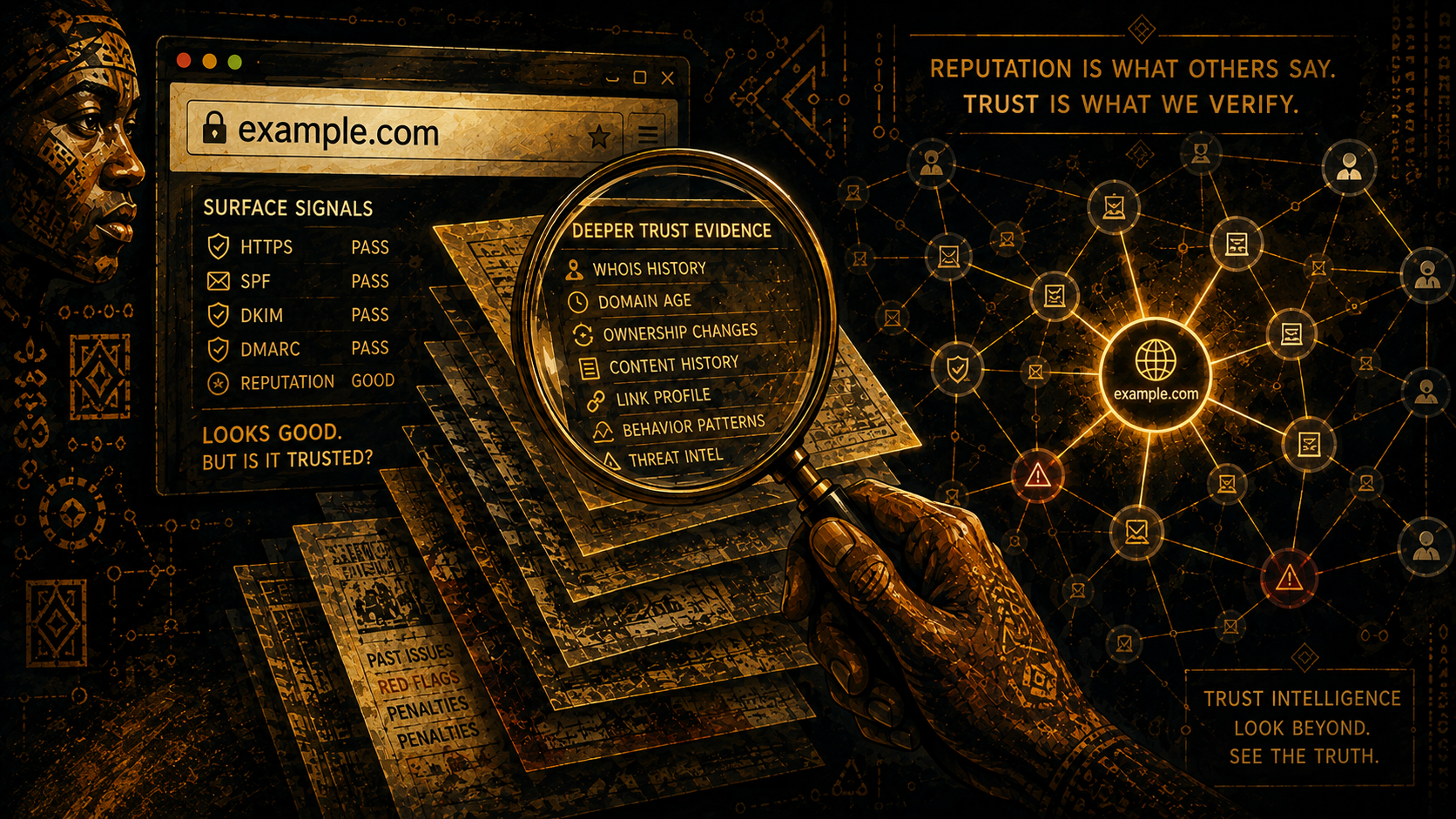
A domain can be warmed. Authenticated. Have a strong sender reputation. Land reliably in the inbox. And still, none of that — alone or together — answers the bigger question underneath it: can this domain be trusted?
That distinction matters more every year, because domains aren’t just being judged by mailbox providers anymore. Security systems, platforms, search engines, AI systems, customers, partners, and automated agents are all forming their own opinions. Email marketing has spent years mastering sender reputation. The next challenge is understanding domain trust.
What Warmup Actually Does
Warmup solves a real problem. A new sending domain — or one that’s been dormant, or one that suddenly spikes in volume — doesn’t have much of a track record with mailbox providers. Warmup builds that track record gradually instead of dumping volume in all at once, so the sending pattern looks legitimate.
The goal is deliverability: can this sender build enough positive signal that its email actually lands?
That’s essential work. But look at what warmup is actually measuring — the domain’s behavior as an email sender. That’s one role a domain plays. It isn’t the whole domain.
A Good Sender Isn’t Automatically a Trusted Domain
Picture a company you’ve never encountered. Its authentication is set up correctly. It’s not on any obvious blocklists. Its sending pattern looks established. Its campaigns land in the inbox.
What have you actually learned? Quite a bit about its ability to send email well. Almost nothing about the domain itself — whether its broader footprint holds together, what history surrounds it, whether real reputation concerns exist outside the email world, whether the organization behind the domain matches the evidence around it, or whether something significant just changed.
Deliverability is evidence. It’s not the whole case.
Reputation and Trust Aren’t the Same Thing
Reputation is what a specific ecosystem has learned about an entity. A sender builds reputation with mailbox providers. An IP builds reputation with security systems. A merchant builds reputation with a payment processor. A website can build reputation with browsers, search engines, security vendors, and customers — separately, and not always consistently.
A domain can look excellent in one of those contexts and raise real questions in another. That’s why one reputation score shouldn’t get treated as a universal verdict on trust.
Authentication Proves Something — Just Not Everything
SPF, DKIM, and DMARC matter enormously. They establish whether mail is authorized, whether a message has been tampered with, and how a receiving system should respond when something fails. Every serious sender should have these locked down.
But authentication gets mentally promoted into something bigger than it is. Authentication asks whether something is technically legitimate within a defined relationship. Trust asks whether you should actually rely on the entity you’re dealing with. Those aren’t the same question. A malicious operator can configure everything correctly. A legitimate business can configure it poorly. Neither fact settles the trust question on its own.
The Used-Domain Problem
Companies acquire domains constantly — agencies inherit client infrastructure, businesses grab expired domains, brands consolidate properties, founders buy up domains with years of history, marketing teams revive dormant ones for new campaigns.
To the current owner, the domain feels new. To the internet, it might be anything but. That raises a question that should come before warmup: what did we actually acquire?
A domain can carry years of history from previous operators. That history doesn’t automatically make the new owner responsible for it — but ignoring it isn’t useful either. What actually happened? How long ago? Was it a one-off or a pattern? Has ownership or behavior clearly changed since? Does recent evidence line up with the older evidence, or contradict it?
Those are trust questions. A warmup tool was never built to answer them.
The New-Domain Problem Runs the Other Way
Now flip it: a legitimate startup with a brand-new domain. Almost no sending history. Sparse reputation data. It may need to warm up carefully just to get moving.
Does that make the domain untrustworthy? No — it means the evidence is thin. That’s a different thing entirely, and a credible trust system has to tell the two apart.
Unknown isn’t the same as bad. Otherwise every new organization starts out guilty until proven innocent.
Warmup Improves a Signal. Trust Intelligence Reads the Whole Picture.
Warmup is an intervention — it tries to shape sender behavior so mailbox providers build confidence over time. That’s exactly what it should do.
Trust intelligence does something different. It observes. It weighs the evidence that already exists. It checks whether different signals agree with each other, contradict each other, have gone stale, or need more context before they mean anything.
Warmup tries to improve reputation. Trust intelligence tries to understand trust. Neither one replaces the other.
Understand the Domain Before You Warm It
The usual workflow looks like this: acquire domain → configure email → authenticate → warm → send → monitor.
There’s a missing step between acquiring the domain and warming it: what’s the trust condition of this domain right now? That question matters most with acquired domains, expired domains, dormant domains, inherited client domains, secondary sending domains, rebranded properties, unfamiliar partner domains, and anything entering a high-value campaign. Before spending weeks building sender reputation, it’s worth knowing what you actually started with.
This Is the Gap WarmBadge Fills
WarmBadge isn’t an email warmup service. It’s a domain trust intelligence system. Instead of manufacturing positive sending activity, it evaluates the broader evidence surrounding a domain — and answers the question that comes before “has this been warmed enough”: what does the evidence actually say?
Email reputation, technical configuration, historical record, reputation signals from other systems, recent changes, context — all of it can matter. But no single signal gets to stand in for the whole truth.
And critically: association isn’t guilt. Legitimate infrastructure gets abused constantly. Major platforms host bad actors. Brands get impersonated. Sites pick up links they never asked for. A real trust system has to separate evidence about a domain from activity that just happens to occur near it — otherwise it’s not measuring trust, it’s measuring proximity.
The Question Underneath the Question
A warmup platform asks: can we build this domain into a healthy sender? WarmBadge asks: can this domain be trusted?
Sometimes both answers land the same way. Sometimes a domain needs warmup despite raising no trust concerns at all. Sometimes a technically flawless sender deserves a much closer look. And sometimes there just isn’t enough evidence yet to say much of anything with confidence. That’s not a flaw in the system — that’s the point of having one.
Email Isn’t the Only Machine Judging Your Domain Anymore
For years, marketers mainly worried about how Google, Microsoft, and Yahoo’s spam filters read their domain. Those still matter enormously. But they’re no longer the only ones forming an opinion. AI systems retrieve information from websites. Search systems evaluate sources. Automated agents interact with businesses directly. Security platforms assess infrastructure. Applications pull domain intelligence through APIs.
Machines are increasingly deciding what to retrieve, recommend, ignore, flag, or trust. The question isn’t just “will a machine accept my email” anymore. It’s what will machines conclude when they look at my domain at all.
Deliverability Is Part of the Picture — Not the Whole Picture
None of this makes authentication, sender reputation, inbox placement, or responsible sending practices less important. It just puts them in context. A domain is more than its email. And reputation in one ecosystem is not automatically trust everywhere else.
So before asking how fast a domain can be warmed, it’s worth asking the question that comes first: can this domain be trusted?
Check your domain’s trust foundation
The WarmBadge Intelligence Fabric evaluates the signals AI systems check before your content enters the picture. Free. No account required.
Check Your Domain →